
Before the hornbeam hedges matured into the tall guardians of the garden, my least favourite job was not as it is now, hedge-clipping, but the biannual turning of the compost heap. I have a phobic fear of rats and am always convinced that as my fork hits the heap a gigantic fierce looking rat with gnashing teeth and red eyes will jump out at me. Thankfully it hasn’t happened .. yet. However, I have to steel myself for the job and summon up every last bit of courage from the very depths of my wellington boots.
It’s taken me years to realise the importance of composting, as my love of gardening grows and my experience increases it slowly dawns on me how important it is to condition the soil. Homemade compost is the life blood of a garden, not only does it allow us to take responsibility for the disposal of garden waste but it also means that we have organic matter with which to mulch the beds….. and it’s all FREE!
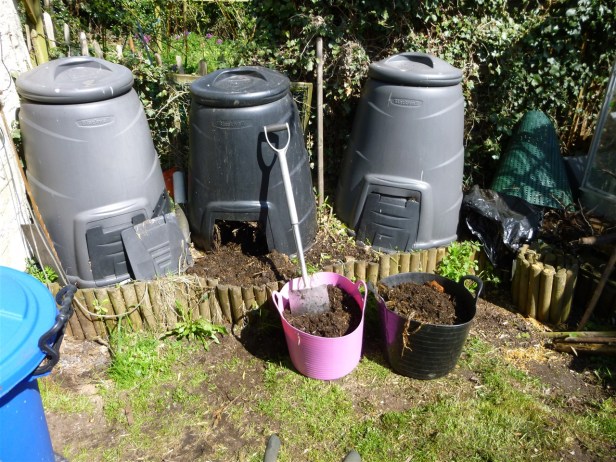 My first compost heap was a a series of 3 plastic compost bins, each one a vessel for a different vintage and grade of decaying organic matter. The bins were hidden behind the shed and as such were never touched by the sun. Decay was slow and on average it would take between 2 and 3 years to produce usable compost. The job of turning the compost was challenging, not only were my nerves stretched to their limits it was also a sensory nightmare, malodorous and muculent. It didn’t occur to me that something wasn’t quite right and of course I was blissfully oblivious to the science of making good compost.
An effective compost heap generates quite a bit of heat and can go up to about 60°C. Heat is generated when bacteria and other microorganisms break down the detritus. To give them the best chance possible of doing their job, to give them optimum conditions so to speak there needs to be mix of green and brown material. Greens are nitrogen rich and include grass clippings, vegetables, fruit and plant waste whilst browns are carbon rich and include woody materials, dead leaves, hedge clippings, cardboard and paper. The most favourable ratio is between 30 or 25 of green to 1 of brown. Compost heaps also need moisture and more importantly oxygen, hence the importance of turning them regularly.
I’m afraid that it’s still a hit an miss affair at Hafan yr Hud but I’m glad to say that we have a few more hits than misses. I do have a better understanding of composting techniques than I did at the beginning of my gardening adventure, however between you and me the successes are more about shrewd purchases, a Hotbin that is now the repository of all kitchen waste and a petrol chipper. More about these in a later blog …
 Bara, pridd a Prosecco