
It’s taken me years to be able to identify common garden weeds and there are still times when I’m completely stumped by an unfamiliar weed. A well known definition of a weed is a plant that’s growing in the wrong place. I don’t quite hold with that philosophy, to me a weed is a plant that I don’t want to be anywhere near the garden. In general weeds fall into two categories, annuals and perennials.
The raison d’etre for any plant is propagation and proliferation and weeds excel at it. If possible it’s best to avoid using weedkiller, unless you’re starting a new garden or have a major weed problem. The best method of managing weeds is to weed regularly either by hoeing or hand weeding. For the last few years I’ve adopted a no dig system and mulch all the beds regularly. This avoids disturbing and activating dormant seeds that lie deep within the soil.
Identifying weeds in their immature form is half the battle. Weeding at this early stage prevents the plant from setting seed. Annual weeds grow and mature quickly, in some cases as little as 4 weeks from germination to setting seed. The seeds are prolific, ignore weeds at your peril because they will eventually invade and appropriate your garden. These are a few of the most common annual weeds.
Hairy Bittercress (Cardamine hirsuta)


This is a very common weed. It grows to a height of about 3-5cm and has small white flowers that will set to seed very quickly, sometime within 4 weeks of germination. Because of its size and form it can hide and is very easily overlooked, leaving it to scatter its seed over a wide area.
Chickweed (Stellaria media)

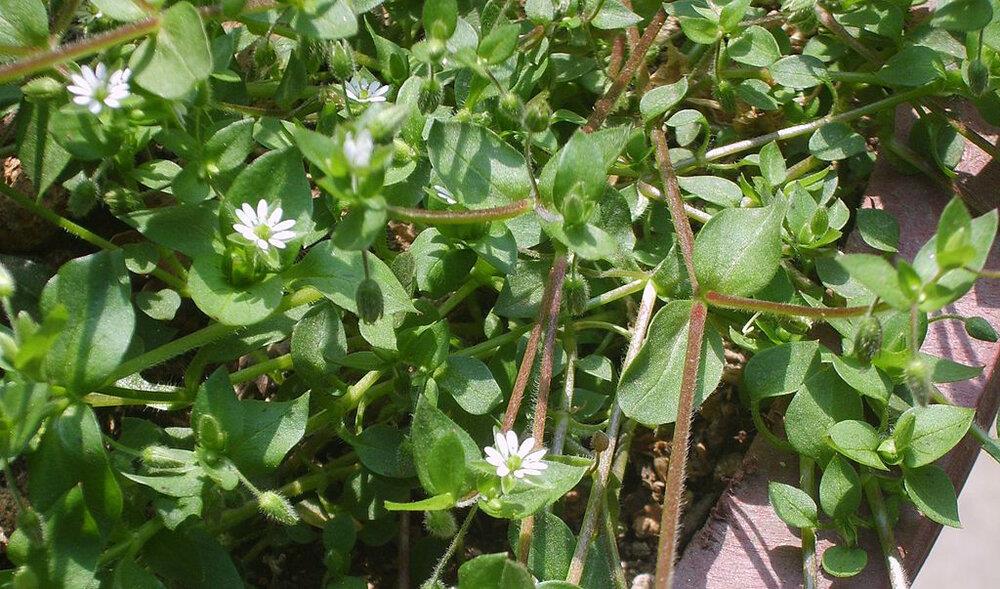
Chickweed will reach a height of about 5-7cm and similar to the hairy bittercress is a prolific seeder. This together with an extensive root system allows it to spread quickly if ignored. It has small white starlike flowers and is a hardy plant and will survive the Winter.
Groundsel (Senecio vulgaris)

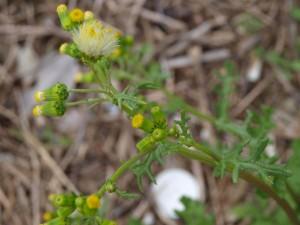
Groundsel is another common annual weed and depending on the soil and location it will grow to a height of between 5cm-22cm. It has small yellow flowers that form seed heads similar to dandelions and will set seed within 4-6 weeks, with one plant setting hundreds of seeds.
Willowherb, or fireweed (Chamerion angustifolium)

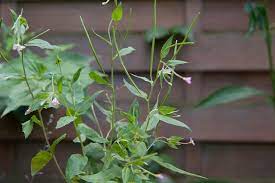
This is another prolific seeder. It has attractive pink flowers and looks lovely in the hedgerow but in a garden it can be invasive and can restrict the growth of other plants. It spreads by seed and tough underground roots and left to its own devices will form dense clumps.
Prickly Milk (Sow) Thistle (Sonchus asper)
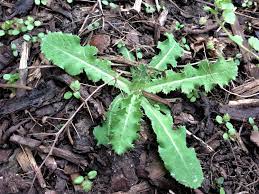
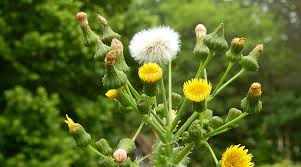
You need to be vigilant of this weed, it will grow up to 90cm tall and has small yellow flowers that will set seed within 4 weeks of germination. Sow thistle needs to be spotted and removed early as it has strong tap roots which makes it difficult to eradicate.
Shepherds purse (Capsella bursa-pastoris)


In its immature state Shepherds Bush’s cluster of serrated leaves can be mistaken for a dandelion. Its thin stems grows to about 10cm and is topped by small white flowers. It will set seed in 6 to 8 weeks and as it matures its roots will also become stronger and deeper so again this is a plant that need to be spotted early and weeded out.
Woodsorrel (Oxalis)
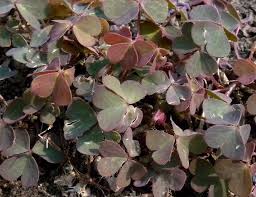
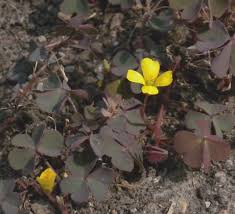
This is a sly one and is hard to spot, it is also quite pretty. It’s low growing (about 5cm) and will set seed very quickly if not weeded.
Fat Hen (Chenopodium Album)
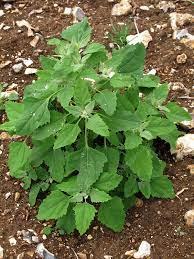

Fat Hen, which by way is a member of the brasscia family, is a good source of vitamin C should you wish to try it. It likes a rich soil and very often can be found in the vegetable patch. In its immature form it looks innocuous but don’t be fooled, it can grow to a height of 27cm; if you leave it to seed you’re setting yourself for a weeding challenge. Seeds can remain dormant in the soil for up to 20 years.
Charlock (Sinapis arvensis)


This is another member of the brassica family. It will set seed within 8-10 weeks after germination and can reach a height of 60cm. This is easy to hoe and to hand weed and again the trick is to catch it early.
Common Fumitor (Fumaria officinalis)
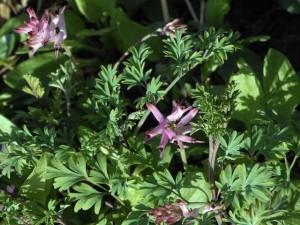
This plant likes undisturbed ground and more than likely you will find it in and around the edges. Depending on its location it will grow to a height of between 10 and 40cm. It has feathery pink flowers and is not a very invasive weed.
Speedwell (Veronica persica)
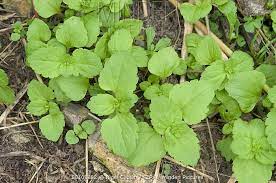

Speedwell has a low growing habit and has lovely blue flowers. I quite like it and have a small clump growing by the gate. However it is a weed and as such I do weed periodically!
 Bara, pridd a Prosecco